

Stow Maries Great War Aerodrome Frontline: Faces and Spaces
Event Details
Stow Maries Great War Aerodrome Frontline: Faces and Spaces
Join us to explore key aspects of the Great War in our popular annual seminar. This year's theme - Key faces, spaces and their impact.
The popular seminar returns!
A one-day focused history seminar, on an original Great War site, in an original great War Building?
Tell me more!
Frontline is a opportunity and an annual, must-go event for the Great War history enthusiast. You will join a restricted number of your peers as you explore a specific area of this wide ranging and complicated field.
With talks in previous seminars ranging from the tribulations of recreating a Great War Aircraft (from drawing board to actual flight) to the challenges of excavating a totally buried Royal Flying Corps Camp, you can guarantee an interesting an exciting day, beginning when you arrive at the museum at 0900hrs.
The exact timings of the day will be confirmed to registered delegates, but you can expect to be finished by 1700hrs.
For 2026, year, the theme is 'Faces and Spaces'.
The day includes up-close and personal tours of aircraft & object handling sessions, as well as lunch in the original 1917 Airmen's Mess.
Finishing off the day with that Q&A session with our experts, you will leave informed, educated and excited about a day well spent.
Propeller Members are eligible for a reduced admission fee to this event. Please contact the Propeller Club team to arrange this.

The Speakers
In 2026, following a broad and comprehensive assessment of the applications received, we are happy to confim that we will be joined by the following speakers:

Peter Hart
Peter Hart has worked for some 40 years as the oral historian for the Department of Sound Records, Imperial War Museum where he interviewed countless veterans. He has written several books on the First and Second World Wars, is an experienced civilian/military tours guide and has appeared in numerous television documentaries.
His books include;The Somme, Jutland 1916, Bloody April, Passchendaele, Aces Falling, 1918 - A Very British Victory and Gallipoli. He is a regular contributor to Britain at War magazine.
In recent years, Hart has been a frequent visitor to the Gallipoli Peninsular, accompanying group tours of the battlefields.
After retiring from the Imperial War Museum, Peter launched "Pete & Gary's Military History" podcast. The debut podcast was made available in February 2020.
Peter's Talk is titled: I'm Out: Escape from German POW Camps, 1914-18
Nobody really expected to be made a prisoner of war but once captured it was a cruel, hard world, especially if they weren’t officers. At the mercy of bullying captors, often existing on a minimal diet that left them suffering from malnutrition, forced to work long hours in appalling conditions, many were too damn exhausted to try and escape. But a few roused themselves and devoted countless hours to escape plans, some taking opportunistic advantage of any brief opening, others engaging in the hard graft of tunnelling. But escape was no guarantee of liberty; many were all too soon caught, to be ignominiously dragged back to the POW camps. For such men failure was only a spur to greater efforts as they try, try, tried again. This is a story of courage and endurance we should not forget.

Neil Bond
Neil Bond began his relationship with 20th century conflict history at a young age – when he was given a set of Great War medals as a child by his grandmother. Since then, he has had an enduring interest in the Great War. In particular, for the last two decades, he has been a keen student of the role of Army Chaplains in the Great War. He has been an active participant in living history activities and historical presentations including representing both the Royal Army’s Chaplains’ Museum and Talbot House at numerous events. He has been the Chair of the Hampshire & Isle of Wight branch of the Western Front Association for the last seven years. He continues to be a regular visitor to the former battlefields of the Great War.
Neil will be presenting a talk called "Tubby and Talbot House”
This stry begins on 11th December 1915, when Army Chaplain Philip Byard Clayton, affectionately known as ‘Tubby’, opened Talbot House as club for all service men in Poperinghe, Belgium. Known by the signaller’s shorthand as ‘Toc H’, it was a sanctuary from the trenches and a touch of paradise in hell for all those to visited. It was the inspiration for the ex-servicemen’s charity, Toc H, in the post war period, which continues to this day. The House still exists as a museum and guest house continuing the great traditions founded in 1915. This is the story of this remarkable man, what the House came to mean to all those it touched, and the lasting legacy of his creation.

Sarah Paterson
Sarah Paterson has worked at the Imperial War Museum in London since 1988, initially as a Librarian and more recently as a Curator in the First World War Team. She grew up in an RAF family, spending much of her young life on RAF Gatow in Cold War Berlin. She has written and spoken widely on military genealogy, and has particular interests in prisoners of war and civilian internees, forces families, military architecture, women in warfare and the British Occupation of Germany after both world wars. Relevant publications include Tracing Your Prisoner of War Ancestors: The First World War: A Guide for Family Historians and Most Secret: M.I.9 Escape and Evasion Devices.
Sarah's talk is titled Hellminden to Blighty: The July 1918 Great Escape from Holzminden Prisoner of War Camp and its legacy . On the night of 23-24 July 1918, 29 prisoners of war crawled out of Holzminden Prisoner of War Camp through a laboriously excavated tunnel that had been months in the making. Ten of those officers – all aviators – made successful home runs after overcoming many difficulties and adventures. This talk looks at the escape and the men involved in it but also considers its legacy. What happened to those involved after the summer of 1918, and how did it influence World War Two escape and evasion? This talk will complement the must-see exhibition on this Great Escape currently on show at Stow Maries Great War Aerodrome, which was opened by Sarah.

The Tours
As part of your delegate's admission, you will enjoy a behind-the-rope tour of the Aircraft collection, showcasing the rare Albatros, Tabloid, Avro and BE2e aircraft. During the tour, you will be free to take photographs and ask questions.

Handling Sessions You will have a chance to get hands-on with a selection of our Objects, drawn from the collections indivudually for this year's event.
Lunch
Lunch will be a buffet style affair, with refreshments, as part of your admission. It will be served in the1917 Airmen's Mess. Yes - you will eat where the personnel of 37 Sqn, RFC (later RAF) ate!
You will be able to purchase additional drinks and snacks during the day from our Cafe.
Location
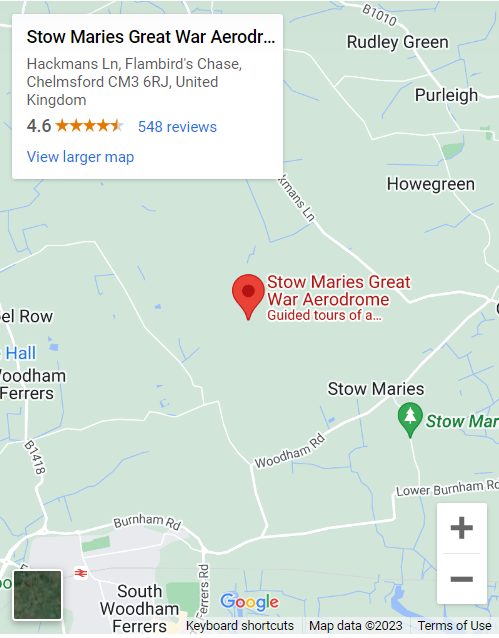
Stow Maries Great War Aerodrome
Flambird's Chase, Chelmsford, CM3 6RJ
Click here to get Google Map directions to the site entrance from your location. See also: Directions by Road
Ticket Prices
-
Frontline: Faces & Spaces Single Admn (14 years +): £ 35.00
+ £ 3.02 Fee - Sales end at 5pm on 08 Oct 2026
Other Upcoming Events

Stow Maries: Autumn Family Nature Day

Stow Maries Great War Aerodrome Remembrance Parade 2026

Experience Christmas lunch in a unique World War One Aerodrome
Experience Christmas lunch in a unique World War One Aerodrome
Please enter at least 3 characters